Thrift, Transform, Wear: A Practical Guide to Turning Secondhand Finds Into Original Works of Wearable Art
The thrift store has always been a place of possibility — racks of other people's histories, waiting to be recontextualized. What has changed, with considerable speed over the past several years, is the sophistication and intentionality with which a new generation of American consumers is approaching that possibility. What was once called thrifting has evolved into something more deliberate: a creative practice that sits at the intersection of environmental ethics, personal expression, and genuine artistic skill.
This is not nostalgia for the 1990s vintage revival, nor is it a purely economic response to inflation, though both of those forces are present. It is something more considered — a rejection of the idea that originality must be purchased at full retail price, and an embrace of the idea that the most personal garment is one you have, in some meaningful sense, made your own.
Why This Moment Is Different
Previous generations of DIY fashion enthusiasts operated largely in isolation — a teenager in Ohio cutting and re-sewing thrift store jeans without any particular audience or community. The current movement is structurally different because of the platforms that now connect practitioners across geography and skill level. TikTok's short-form video format is particularly well-suited to the transformation reveal — the before-and-after structure that makes a plain denim jacket's journey to embroidered masterpiece immediately legible and deeply satisfying to watch.
The numbers reflect this shift. ThredUp's 2023 Resale Report estimated the US secondhand apparel market at $43 billion, with projections to reach $70 billion by 2027. Significantly, the growth is not driven solely by resale of unaltered pieces. The customization and upcycling segment — people buying secondhand specifically to transform — represents one of the fastest-growing categories within that market.
The environmental dimension is not incidental to this appeal. Gen Z consumers, who have grown up with climate change as a defining backdrop, are acutely aware of fashion's environmental footprint. The textile industry is responsible for approximately 10 percent of annual global carbon emissions, and the United States alone discards roughly 11 million tons of textile waste each year. Choosing to transform an existing garment rather than purchase a new one is, for many young Americans, both a creative act and a conscientious one — and the fact that the resulting piece is also more original than anything available at a mall is not lost on them.
Building Your Thrift Sourcing Practice
Before any needle is threaded or paint brush lifted, the foundation of a strong upcycling practice is thoughtful sourcing. Not every thrift store find is equally suited to transformation, and developing an eye for promising raw material is itself a skill worth cultivating.
Prioritize natural fibers. Cotton, linen, wool, and denim accept embroidery, paint, and dye far more readily than synthetic blends. When in doubt, check the garment tag. A 100 percent cotton denim jacket is a significantly more versatile canvas than a polyester-cotton blend.
Assess structure over surface. A garment with a strong silhouette but surface damage — fading, minor staining, small tears — is often more valuable than a pristine piece with a weak cut. Surface issues can be addressed or incorporated; structural problems are harder to resolve without advanced sewing skills.
Think in terms of canvas, not clothing. When you are browsing, ask yourself not what the garment currently is but what it could become. An oversized men's button-down shirt is a blank canvas for hand-painted abstract work. A pair of wide-leg trousers is a surface for botanical embroidery. A denim trucker jacket is one of the most versatile customization substrates available at any price point.
Shop with a project in mind. Aimless browsing produces aimless acquisitions. Before a thrift run, identify one or two techniques you want to practice and let those guide your selections.
Core Techniques for Beginners
The following techniques represent the most accessible entry points into garment customization. Each requires modest investment in tools and can be learned to a functional level within a few hours of practice.
Embroidery
Hand embroidery is perhaps the most enduring and versatile of the customization techniques currently experiencing a renaissance. The basic toolkit is minimal: embroidery hoops in two or three sizes, embroidery floss in your chosen palette, a set of embroidery needles, and a water-soluble fabric marker for sketching designs.
Begin with the satin stitch and the backstitch, which together can produce an enormous range of imagery. Floral motifs are perennially popular and forgiving for beginners — individual petals and leaves can be worked in sections, and minor imperfections read as charming rather than erroneous. Once comfortable with flat stitching, explore French knots for texture and dimension.
For placement, collar edges, cuffs, and pocket openings on denim or chambray shirts offer contained areas well-suited to focused decorative work. A single embroidered motif in the right location transforms a garment more effectively than dense coverage everywhere.
Iron-On and Sew-On Patches
Patches represent the lowest barrier to entry of any customization technique, and their expressive range is considerably wider than their simplicity might suggest. The current market for patches in the United States is rich — independent illustrators sell hand-embroidered patches through Etsy and at craft markets, while vintage military and band patches carry their own distinct aesthetic weight.
For longevity, reinforce iron-on patches with a few anchor stitches at the corners, particularly on garments that will be laundered frequently. The combination of heat bonding and hand stitching produces a more durable result than either method alone.
Composition matters. A single large patch placed with deliberate asymmetry reads as a design decision. A scattered arrangement of small patches across a jacket back can build into a cohesive visual narrative if the pieces share a tonal range or thematic thread.
Hand Painting and Bleaching
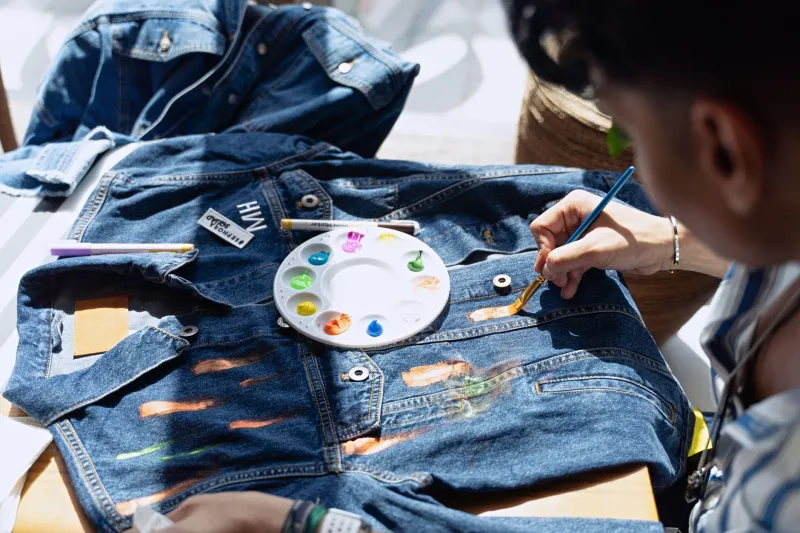
Fabric paint and textile medium open the full vocabulary of visual art to garment customization. Tulip, Jacquard, and Angelus are among the most widely available brands in the United States, each offering formulations suitable for different fabric types.
For beginners, work on pre-washed, 100 percent cotton. Sketch your design lightly with a fabric marker before committing with paint. Build color in thin layers rather than applying heavily at once — this produces more even coverage and reduces the risk of cracking as the paint cures.
Bleach work on dark denim or black cotton produces striking results with minimal technical skill required. Diluted bleach applied with a brush, sponge, or spray bottle creates tonal variations that read as intentional and sophisticated. Always work in a well-ventilated space and neutralize bleach-treated areas with a diluted hydrogen peroxide rinse before laundering.
Thinking Like a Designer
The techniques above are tools. What elevates their application from hobbyist experimentation to something approaching genuine design is the same quality that distinguishes any strong creative work: intentionality.
Before you begin a project, spend time with the garment. Consider its existing character — the wear patterns that speak to its history, the cut that defines its personality, the fabric weight that determines how it moves. Your additions should be in conversation with these qualities, not simply imposed upon them.
At Karvajal Designs, this is precisely the philosophy that animates every collection: that a garment is a living thing, shaped by the hands that made it and the hands that wear it. The DIY movement, at its most thoughtful, extends that philosophy into the hands of the wearer themselves — making the act of dressing not a passive consumption but an active, ongoing act of creation.
The thrift store is waiting. So is the blank canvas.