Wearing Your Mood: The Science and Art of Dressing for Emotional Well-Being
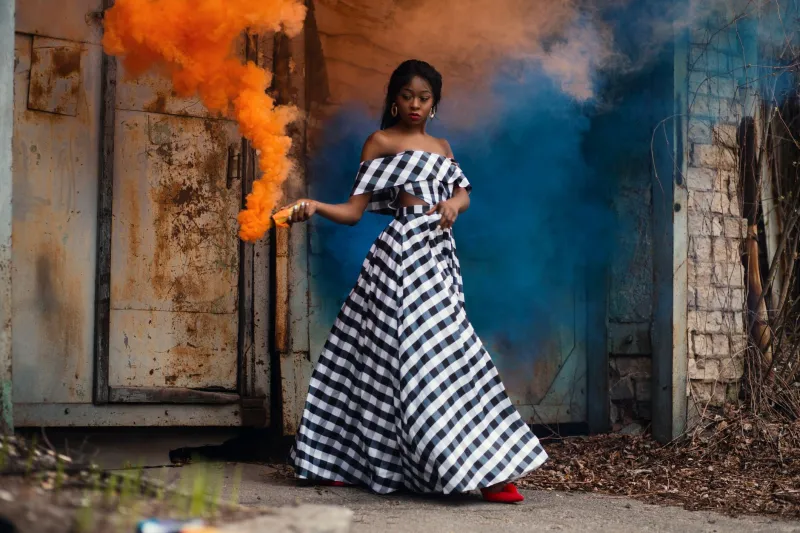
There is a moment, familiar to most of us, when standing before an open closet feels less like choosing an outfit and more like negotiating with oneself. Do you reach for the reliable gray cardigan, or do you take a chance on the cobalt wrap dress that has been waiting patiently on its hanger? Increasingly, researchers and designers alike are arguing that this choice matters far more than aesthetics alone — that color and pattern function as a kind of emotional architecture, quietly shaping the interior landscape of a day.
The concept has been given a name — dopamine dressing — though the phenomenon itself predates the label by centuries. What is new is the science beginning to explain why it works.
What Neuroscience Is Saying About Color and Mood
Dr. Carolyn Mair, a behavioral psychologist specializing in the psychology of fashion, has written extensively on the relationship between clothing choices and cognitive states. Her research, along with a growing body of work from institutions including the University of Rochester and the Fashion Institute of Technology, suggests that color perception activates distinct neurological responses. Warm hues — saturated yellows, terracotta oranges, and coral reds — are consistently associated with elevated energy and heightened social engagement. Cooler, deeply saturated tones like cobalt blue and forest green tend to promote calm focus.
The mechanism is not purely symbolic. Photoreceptors in the eye transmit color information directly to the hypothalamus, which governs hormone regulation, including the release of serotonin and cortisol. In plain terms: what you see when you look down at what you are wearing is actively communicating with your brain's chemistry.
Color psychologist Angela Wright, whose work has informed branding campaigns and architectural design across the United States, frames it this way: the relationship between color and emotion is not arbitrary cultural assignment. It is a biological inheritance, refined over millennia, that modern design can either work with or against.
Engineering Joy: A Designer's Perspective
At Karvajal Designs, the conversation about color is never incidental. The design process begins not with trend forecasts but with what might be described as emotional briefs — internal documents that articulate the feeling a collection is intended to produce before a single fabric is selected.
"We ask ourselves what we want someone to feel at 8 a.m. when they are deciding whether to face the day," explains the creative direction behind several of Karvajal's recent releases. "If the answer is 'capable and alive,' that tells us something very specific about saturation levels, about the weight of a print, about whether we are working with geometric precision or something more organic and free-moving."
This intentionality is visible in the brand's current offerings. The Solara blouse, rendered in a hand-illustrated citrus print, was developed in direct conversation with findings from color therapy research. The pattern density was calibrated to be stimulating without becoming visually fatiguing — a distinction that requires the kind of nuanced craft that separates artistic apparel from mass-produced novelty.
Similarly, the Indigo Field trousers — a deep, slightly variegated navy featuring an abstract botanical overlay — were conceived as a piece for the wearer who needs to feel both grounded and creatively expansive. The dual-toned botanical motif was not decorative afterthought; it was the entire emotional thesis of the garment.
Finding Your Personal Dopamine Palette
The practical question, of course, is how an individual identifies which colors and patterns serve their own emotional needs rather than simply following broader trends. The answer requires a degree of self-observation that fashion culture has not always encouraged.
Begin by conducting what color therapists call a wardrobe audit with intention. Rather than evaluating pieces by how they look in isolation, notice how you feel when you wear them — not how you feel about the compliments you receive, but how you feel internally, in your body, mid-afternoon on an ordinary Tuesday. Pieces that consistently correspond with elevated mood, sharper focus, or a greater sense of ease are the foundation of a personal dopamine palette.
Several additional strategies can help refine this process:
Track your choices against your days. Keep a simple log for two weeks. Note what you wore and how the day felt emotionally. Patterns will emerge that no style quiz can replicate.
Distinguish between colors you admire and colors that serve you. Many people are drawn to neutrals aesthetically but find that wearing them exclusively produces a kind of emotional flatness. Admiration and personal utility are not the same.
Introduce saturation gradually. If you have spent years in a muted wardrobe, a full pivot to maximalist prints can feel performative rather than authentic. Begin with one statement piece per outfit — a printed scarf, a single bold blouse — and observe the response, both internal and external.
Consider pattern scale alongside color. Large-scale prints tend to project confidence and presence. Smaller, intricate patterns often communicate a more inward, thoughtful energy. Neither is superior; both are tools.
The Broader Cultural Shift
The dopamine dressing conversation is arriving at a particular moment in American culture — one marked by widespread acknowledgment of mental health challenges and a growing interest in accessible, everyday wellness practices. Fashion, historically framed as superficial, is being reconsidered as a legitimate domain of self-care.
This reframing aligns naturally with the ethos at the core of Karvajal Designs. The brand has long operated from the conviction that clothing is not merely functional covering but expressive infrastructure — the daily interface between a person and the world they move through. When that interface is thoughtfully constructed, when it carries genuine artistic intention, it does more than communicate identity. It actively participates in shaping it.
The gray cardigan has its place. But so does the cobalt dress. The emerging science simply suggests that choosing between them is worth taking seriously.